ISO 9001:2026 and AI: Practical Controls for Everyday Quality

Free presentation for quality teams — PDF and editable PowerPoint

AI can help teams find information, analyze complaints, and prepare quality reviews. Its outputs still need appropriate checks. Explore four everyday QMS examples, with practical controls, verification steps, and evidence to retain. Download the free PDF or get editable slides to adapt for your team.

Get the Editable PowerPoint

Free with your email.

18 slides · PDF (914 KB) or editable PowerPoint (854 KB) · Edition 1.0, October 2026
ISO 9001:2026 and AI presentation on practical quality controls, available as a free PDF and editable PowerPoint.
The short answer

Where AI can affect a quality decision

AI tools already help with everyday quality work: searching procedures, summarizing complaints, drafting reports. For a QMS, the useful question isn't how clever the tool is. It's what happens if the output is wrong and nobody checks it.

A draft email that needs tidying is low risk. An AI summary that hides a serious complaint, or points someone to an obsolete work instruction, can affect product conformity and customer satisfaction. So the strength of the check should follow the consequence of an error.

You don't need a separate system for this. The checks fit processes you already run: documented information (clause 7.5) for approved sources and current revisions, competence (7.2) for the people who use and review AI outputs, analysis and evaluation (9.1.3) for complaint data, corrective action (10.2) for causes, and internal audit (9.2) for evidence-based findings.

What ISO 9001:2026 requires

No AI-specific requirements

Based on CBG's clause-by-clause comparison with the 2015 edition, the 2026 revision adds no AI-specific requirements and doesn't require you to use AI. Where AI is used in a QMS process, that process's existing requirements still apply.

What the standard explains

Knowledge in digital systems

The 2026 note to clause 7.1.6 lists knowledge “held in documented information, digital systems and other media” among the forms organizational knowledge can take. A note explains; it doesn't add a requirement.

What CBG suggests

Proportionate checks

The examples, checks and pilot approach on this page and in the presentation are CBG's own suggested practices, not ISO requirements. Adapt them to your processes and risks.

Four everyday examples

Useful AI tasks, and the check that keeps them reliable

Illustrative CBG scenarios, not ISO requirements. Each one pairs a task where AI saves time with the most likely way it goes wrong.

Four QMS activities where AI can help, what could go wrong, and a suggested check
QMS activity Useful AI task What could go wrong Suggested check
Document search Locate an applicable instruction. An obsolete revision is used. Check the approved source and current revision before acting.
Complaint analysis Group complaints into themes. A rare, serious case disappears in the summary. Trace results to originals and review critical exceptions separately.
Corrective action Organize facts and suggest possible causes. An explanation is accepted without evidence. Treat suggested causes as hypotheses and test them.
Internal audits Highlight records for investigation. An unsupported observation becomes a finding. Have the auditor verify evidence against applicable criteria.

The pattern is the same in all four: AI speeds up finding or sorting information, and a competent person still makes the decision against the original evidence. Keep evidence of that check, such as the approved document consulted, the original complaints reviewed or the cause actually tested, in the records the process already produces.

Inside the presentation

What is in the presentation

An 18-slide briefing in four parts that you can present to process owners, internal auditors or leadership, or use to start a team discussion about where AI already touches your QMS.

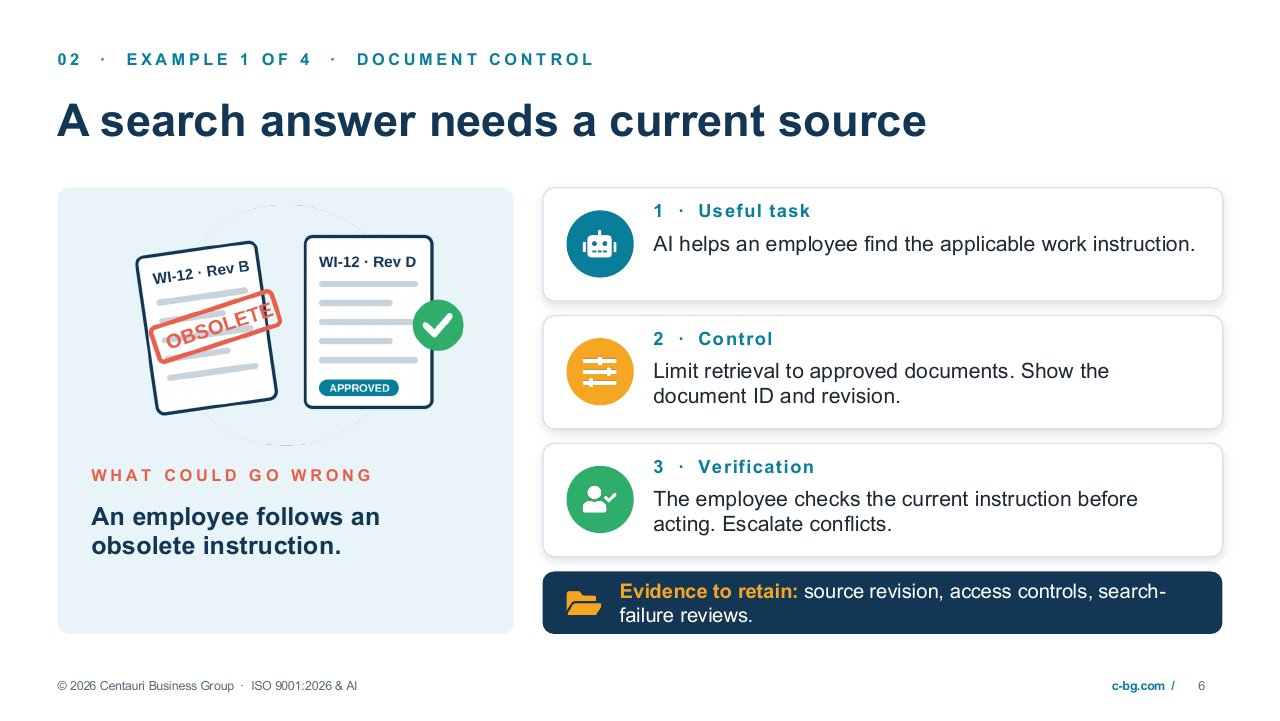
Slide 6, A search answer needs a current source: AI helps an employee find a work instruction, retrieval is limited to approved documents showing ID and revision, and the employee checks the current instruction before acting.
Slide 6: example 1 of 4, document control
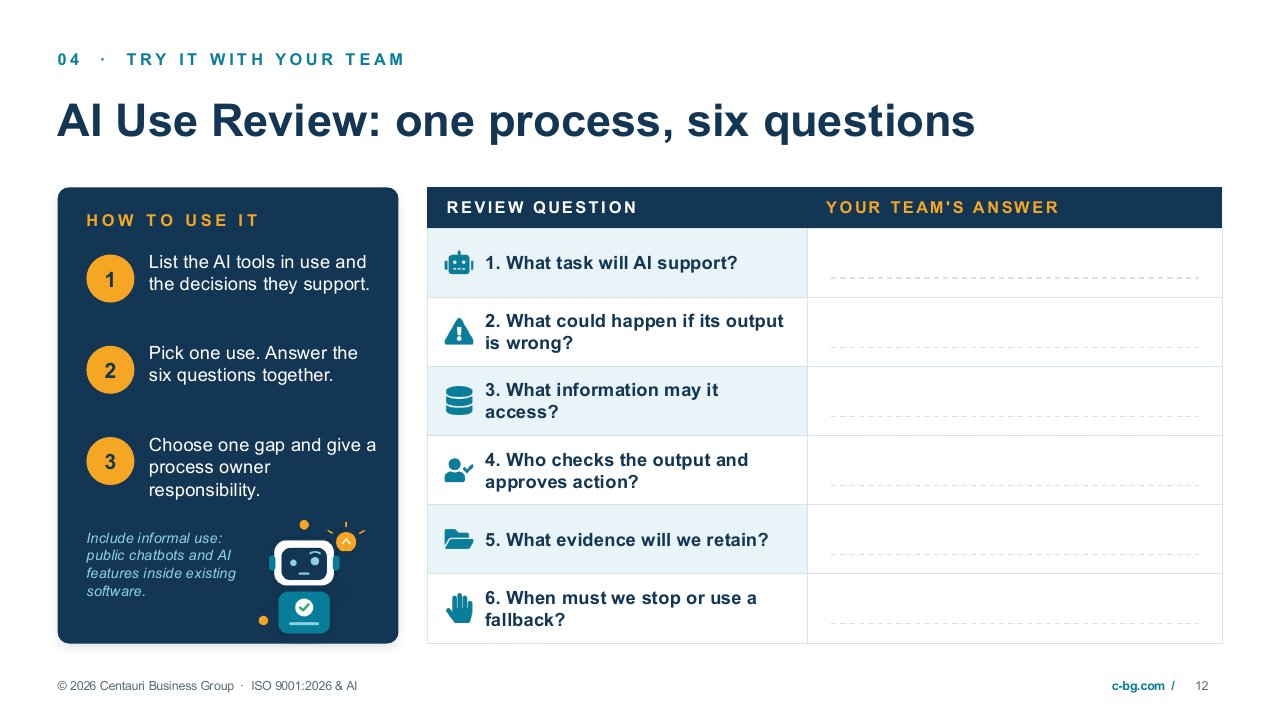
Slide 12, AI Use Review: one process, six questions. A worksheet with blank answer fields for what task AI supports, what could happen if its output is wrong, what information it may access, who checks the output, what evidence to retain, and when to stop or use a fallback.
Slide 12: the AI Use Review worksheet
Free download

Download the free AI presentation

Both formats are free and have the same content. Choose the one that suits how you'll use it.

PDF: read, save and share

Read the briefing, keep it for reference, or share it with colleagues as it is.

Download Free PDF (opens in a new tab)

PDF · 18 pages · 914 KB · No email required

Editable PowerPoint (.pptx)

Get the Editable PowerPoint

Free editable slides for your internal briefing. No purchase required. Adapt the slides and add examples from your own organization.

PowerPoint (.pptx) · 18 slides · 854 KB · Edition 1.0, October 2026

Related CBG resources

Where to go next

ISO 9001:2026 QMS Transition Program & Checklist

For planning the wider transition of your QMS to the 2026 edition.

Paid resource · $84.00

View the QMS Transition Program →

Where the examples meet your procedures (the presentation maps the same ones): QPS 7.5-01 Control of Documented Information sets the approval, revision and access rules an AI search tool should respect, QPS 10.2-01 Corrective Action covers testing a suggested cause and verifying effectiveness, QPS 6.1-01 Actions to Address Risks helps you assess a new AI use before you rely on it, the QPS 9.2-01 Internal Audit procedure covers evidence-based audit findings, and the QPS 9.3-01 Management Review procedure is where pilot results get reviewed. These are QMS procedures, not a complete AI governance system.

Browse all free ISO 9001 resources

FAQ

Common questions

What is the difference between the PDF and editable versions?
They have the same content. The PDF is for reading, saving and sharing as it is. The PowerPoint is the editable version of the same slides, so you can adapt them and add examples from your own organization for an internal briefing.
Do I need to subscribe to marketing emails to receive the PowerPoint?
No. You get the PowerPoint whether or not you tick the marketing box. We add you to our mailing list only if you tick it, and you can unsubscribe at any time.
Can I adapt the slides for an internal briefing?
Yes. You may share the presentation unchanged and present it within your organization, crediting Centauri Business Group. You may also adapt the editable PowerPoint for internal briefings; if you do, mark your copy as adapted from the CBG original. Please don't sell the presentation or an adapted version of it.
Are these suggested AI controls additional ISO 9001 requirements?
No. They are CBG's suggested practices. Based on CBG's clause-by-clause comparison of ISO 9001:2026 with the 2015 edition, the revision adds no AI-specific requirements. Where you use AI inside a QMS process, that process's existing requirements still apply, for example using current, approved documented information (clause 7.5) and making sure the people involved are competent (clause 7.2).
Does this resource replace the ISO standard?
No. It is CBG's educational guidance, not an ISO publication. Use it alongside the ISO 9001:2026 text and your own QMS documentation.
Source base

Sources and credit

Credit. This page and the presentation were inspired by the article ISO 9001:2026 and AI: What Does the New Era of Digital Quality Mean? (opens in a new tab) by Intelligence Quality. The examples, controls and recommendations are CBG's own work, and the credit doesn't imply endorsement by the article's author.

Scope. Educational guidance on using AI within an existing ISO 9001 quality management system. It is not an ISO publication, doesn't replace the ISO 9001:2026 text, and isn't a complete AI governance framework.

All ISO Products