Supplier management
Protect (risk): Dependence on a single source for a critical material or component.
Create (opportunity): Developing a second qualified supplier jointly, improving reliability and cost together.
ISO 9001 Clause 6.1 — transition guidance
Updated for 2026 ISO 9001:2026 was officially published on September 16, 2026. Clause-level statements on this page reflect the published ISO 9001:2026 text and CBG's independent analysis.
ISO 9001:2015 introduced risk-based thinking. The 2026 revision doesn't replace it — it makes the two management responses harder to blur together: protecting what you already have, and deliberately pursuing what could make it better.
Download the free Clause 6.1 guide (PDF) New to the 2026 changes? Start with the Change Guide →
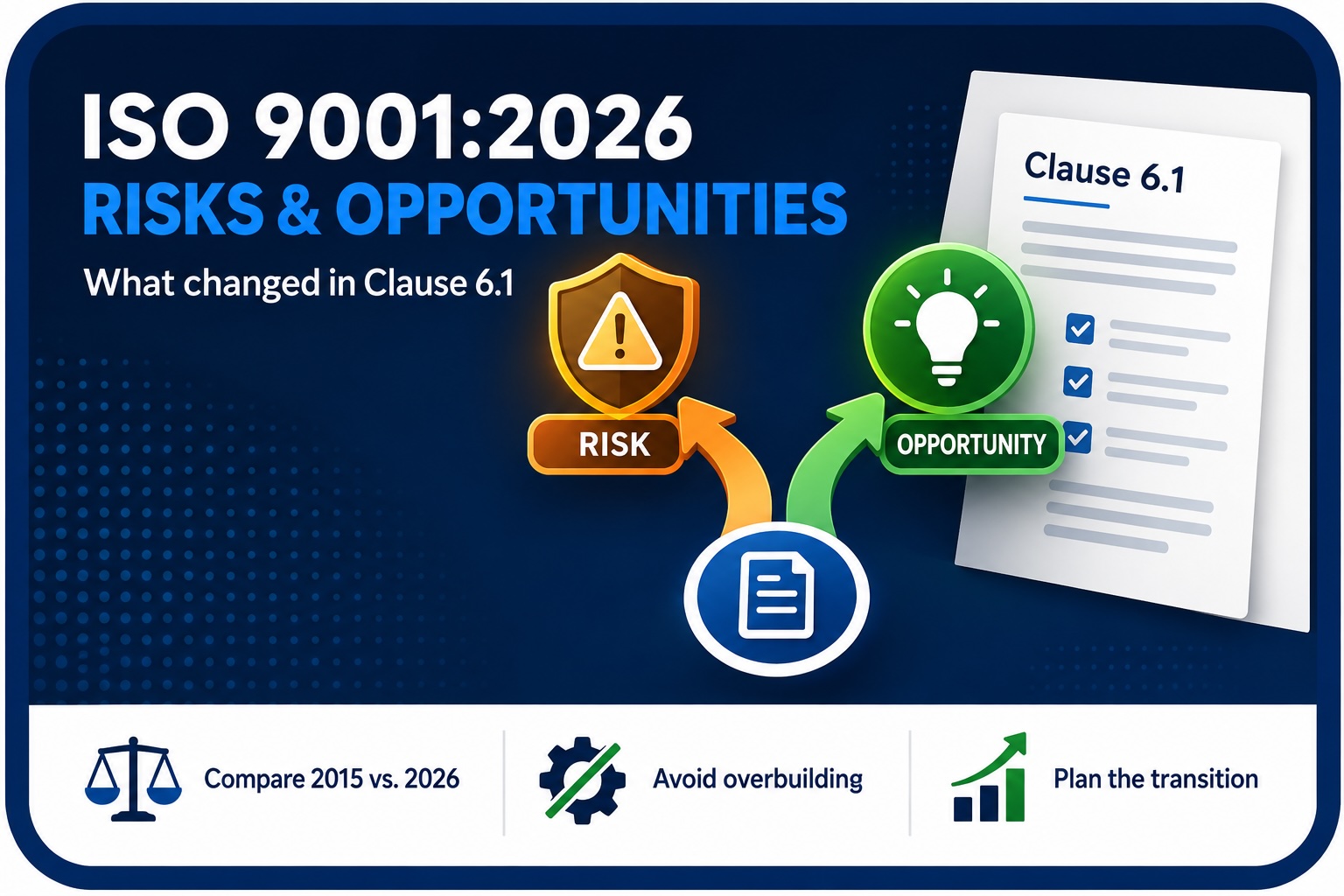
ISO 9001:2015 addressed risks and opportunities together, in one short clause. In practice, many organizations read it mainly as “keep a risk register,” and opportunities often ended up buried inside it, treated as low-priority, or skipped. The 2026 revision gives the subject clearer structure.
Identify, analyze and evaluate risks that could undesirably affect your ability to consistently deliver conforming products and services — then plan, integrate and evaluate the actions you take.
Identify favorable circumstances that could desirably affect that same ability — then apply the same discipline: plan, integrate and evaluate, for the opportunities worth pursuing.
For an organization already conforming to ISO 9001:2015, the real transition question isn't “do we need a second risk-management system?” It's whether your existing planning process gives both sides deliberate, proportionate, traceable treatment — and whether you can show the resulting actions actually got integrated into the QMS and evaluated for effectiveness.
Based on the officially published ISO 9001:2026 text and CBG's independent analysis of Clause 6.1.
| Topic | ISO 9001:2015 | ISO 9001:2026 direction | Transition significance |
|---|---|---|---|
| Clause structure | Risks and opportunities addressed together in 6.1.1 and 6.1.2 | Determination stays together in 6.1.1; action-planning splits into 6.1.2 (risk) and 6.1.3 (opportunity) | Moderate documentation change; potentially significant practice change where opportunities were neglected |
| Risks | Shared the same planning text as opportunities | Own action-planning sub-clause and risk-specific notes | Review whether responses are proportionate and connected to QMS processes |
| Opportunities | Required, but easy to bury inside a risk-focused process | Dedicated sub-clause and examples | Need a visible, repeatable way to select and pursue worthwhile opportunities |
| Continual improvement | Clause 6.1 referred to achieving improvement | Structure reinforces continual improvement | Link opportunity planning to improvement, not a brainstorming list |
| Guidance | Limited explanation in Clause 6.1 / Annex A | Expanded guidance on risk-based thinking and the risk/opportunity distinction | Update training, internal-audit criteria and implementation guidance |
| Context inputs | Internal/external issues and interested-party requirements already fed planning | Same chain, with the 2024 climate-change amendment folded in | Confirm whether climate change is relevant to your QMS — don't automatically invent a climate risk |
A few points are worth stating plainly, because they're the most common way organizations over-engineer a Clause 6.1 response.
The practical weakness in many 2015-era systems was never a failure to identify risks — it was a failure to carry the significant ones through ownership, action, process integration and effectiveness review. The clearer 2026 structure gives auditors, and organizations, a sharper trail to follow:
Opportunities, in particular, now need their own management attention. Useful evidence includes selected improvement initiatives, quality objectives, process-change plans, technology evaluations, supplier-development activity, lessons-learned actions, or approved business cases — not chasing every good idea, but showing a credible route from favorable circumstance to decision, planned action and evaluation.
A risk concerns uncertainty that could adversely affect intended QMS results, product or service conformity, or customer satisfaction. An opportunity is a favorable circumstance that may help you improve those same results. Reducing a threat doesn't automatically capture an opportunity — qualifying a second supplier protects continuity; collaborating with that supplier to redesign a component is a different decision entirely.
“ISO 9001:2015 taught organizations to think about uncertainty. ISO 9001:2026 asks them to make the two management responses clearer: control what could prevent the QMS from succeeding, and deliberately pursue what could make it perform better.”
Centauri Business Group — editorial position on Clause 6.1
Illustrative only — use these as a starting point for identifying your own risks and opportunities, not as a checklist to copy directly into your Risk List.
Protect (risk): Dependence on a single source for a critical material or component.
Create (opportunity): Developing a second qualified supplier jointly, improving reliability and cost together.
Protect (risk): A regulatory or customer-specification change invalidating a current design assumption.
Create (opportunity): A new material, method or standard that lets a planned redesign cut cost or improve durability.
Protect (risk): Critical knowledge concentrated in one person nearing retirement or reassignment.
Create (opportunity): Cross-training that builds resilience and also enables more flexible scheduling.
Protect (risk): Aging equipment or a single point of failure in a production or IT system.
Create (opportunity): A planned technology upgrade that also increases capacity or throughput.
Protect (risk): A seasonal or single-site bottleneck that threatens on-time delivery.
Create (opportunity): A process change that both reduces that exposure and shortens overall cycle time.
Protect (risk): Inconsistent communication of nonconformities or delays to affected customers.
Create (opportunity): Proactive, structured communication practices that increase satisfaction and repeat business.
The 2015-vs-2026 comparison, what has and hasn't changed, the CBG interpretation, and the transition checklist — one plain-language PDF you can keep and share.
Get the editable PowerPoint version of the transition guide — adapt it to your QMS, add your own notes, and present what's changing in Clause 6.1 and what to review first.
These aren't competing risk products — they solve different problems. Start with whichever matches what you need right now.
The entry point for the full transition — every revised clause, not just 6.1. Start here if you haven't reviewed the whole standard yet.
View the Change Guide →An editable working procedure: roles, the four-phase framework, assessment, treatment and effectiveness evaluation. Currently focused on the risk side of Clause 6.1.
View Actions to Address Risks Procedure →Detailed methods, risk matrices, treatment planning, monitoring and field-based examples covering both risk and opportunity.
View Risks & Opportunities Manual →A short, practical guide to what risk is, where it comes from, and how to identify, assess and treat it.
View Risk Management Guide →The system-level framework connecting context, process management, risk-based thinking and improvement.
View Quality Manual →Browse the complete range of QMS templates, procedures, and audit tools updated for the new edition.
View All ISO 9001:2026 Products →The Change Guide, a transition briefing, supplier Q&A, and other free guides — no email required.
Browse Free Resources →ISO 9001:2026 was officially published on September 16, 2026. Clause-level statements on this page reflect the published ISO 9001:2026 text and CBG's independent analysis — see the full Change Guide for the broader transition picture. This summary is provided for educational purposes and is not a substitute for the applicable ISO publication.