SR Glossary of Definitions
Key SR terms and definitions based on ISO 26000:2010.
View GlossaryKey facts, statistics, and curated links on Social Responsibility frameworks, international standards, measurement tools, and management approaches.
Download PDF
The terms Social Responsibility and Sustainability are closely related as they both cover economic, environmental, and social aspects. Companies that report results of their activities in these three areas use various names for their reports, such as: Corporate Responsibility Report, Social Responsibility Report, Business Sustainability Report, Sustainable Development Report, Global Citizenship Report and the like.
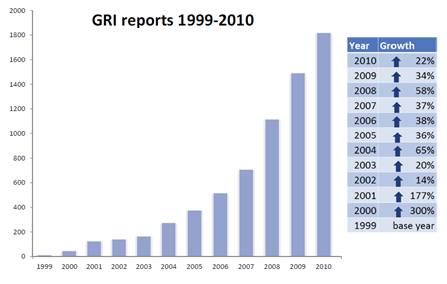
The number of companies that produce such reports is growing exponentially. The graph below shows the growth of reports which were produced in accordance with GRI [Global Reporting Initiative] Guidelines and registered on the GRI website.
While the list of corporate responsibility assessment tools and implementation guidelines is large and diverse, there are seven areas which are common for most of the tools:
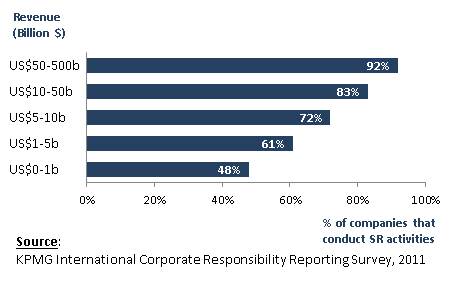
Based on a survey conducted by KPMG in 2011, 95% of the 250 largest companies in the world established SR programs and report on these annually. Large companies are leaders in corporate social responsibility.
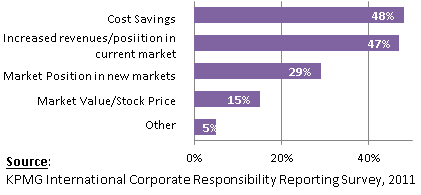
Companies that conduct SR activities see these activities as a driver of financial value that comes from two sources. The first source is direct cost saving through more efficient use of energy, water, and other resources. The second source of financial value is enhanced reputation of an organization that attracts more customers, investors, talented employees, and other stakeholders.
The chart below illustrates SR drivers of financial value as identified by the KPMG 2011 survey.
The concepts of sustainability and social responsibility also influenced the development of international standards.
For instance, in 2005–2010 a strategic plan of the International Organization for Standardization (ISO) was named "Horizon 2010: Standards for a Sustainable World". In a strategic plan 2010–2015 Solutions to Global Challenges, ISO declared that "ISO's portfolio of over 18 500 standards provides business, government and society with practical tools for all three dimensions of sustainable development: economic, environmental and social."
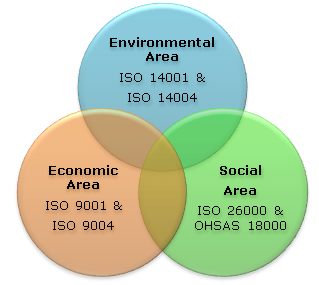
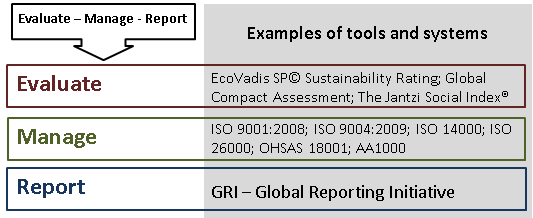
Here are just some examples of international standards in economic, environmental and social areas:
A number of universal tools have been created to evaluate social responsibility and business sustainability of an organization. Here are the most popular ones:
The following aspects are covered by this core subject of SR:

Some countries and industries created their own assessment tools and set of guidelines. Here are some examples:
The following aspects are covered by this core subject of SR:

Some assessment tools and recommendations are focused on specific aspects of corporate responsibility, for example:
The following aspects are covered by this core subject of SR:

SR programs are based on the same key processes and principles as any other management system including the following: policy development, process definition, internal and external audits, management reviews, and continual improvements.
ISO management systems standards, especially ISO 9001 quality management systems, can serve as a perfect platform for the establishment and maintenance of SR programs.
Key SR terms and definitions based on ISO 26000:2010.
View GlossaryIntroduction to Social Responsibility with case studies for quality professionals.
SR Home